Lean Six Sigma Black Belt Training
Lean Six Sigma Black Belt Training and Certification is an advanced practitioner programme designed for experienced professionals who are expected to lead complex improvement initiatives and drive sustained performance change across teams, functions and processes.
Building on prior Green Belt knowledge, the programme develops deeper analytical capability, stronger change leadership skills and the confidence to address more complex, cross-functional challenges. You extend your ability to diagnose performance issues, evaluate improvement options and apply advanced tools and techniques in a range of real organisational scenarios.
For participants who completed Green Belt training some time ago, refresher modules are included to reinforce core concepts and close any gaps in knowledge, ensuring a strong and consistent foundation before progressing.
Advanced analysis is supported through the use of statistical software, including a Minitab trial version, with clear guidance provided upon enrolment so you are fully prepared to use the tools effectively during the programme.
All course content, learning resources, assessments and exams are supported with multilingual language capability, enabling participants to learn, collaborate and apply learning effectively across global and cross-functional environments.
By completing the Black Belt, you return to work equipped to lead high-impact improvement projects, manage resistance to change, coach others through structured problem-solving and contribute at a more strategic level to organisational improvement efforts.
How you benefit
 Lead complex, cross-functional Lean Six Sigma improvement initiatives using advanced DMAIC application Apply advanced analytical and statistical tools to diagnose and validate performance issues Drive sustainable improvement through structured change leadership and stakeholder engagement Coach and support Green Belts and project teams to improve delivery capability Translate data, analysis and insight into actionable business decisions
Participant Profile:
This Black Belt programme is suited to experienced improvement practitioners from manufacturing, service and transactional environments, including senior project and change managers, operational leaders, improvement specialists and consultants who are responsible for leading complex initiatives and influencing performance beyond a single team or function.
Participants are typically expected to take ownership of high-impact improvement work, support other practitioners and contribute to the wider deployment of continuous improvement capability within their organisation.
Course Pre-requisites
Prior Lean Six Sigma Green Belt certification or equivalent experience is required.
Exam and Certification
Online multiple-choice exam
50 questions
70 minutes
Pass mark: 70%
Successful completion results in Lean Six Sigma Black Belt certification.
Intensive, immersive Black Belt training completed in five days.
The Black Belt Face-to-Face programme is designed for experienced practitioners who want the depth, pace and challenge of an immersive classroom environment. Delivered over five consecutive days, it allows you to complete your training in a focused, uninterrupted block, accelerating capability development without extending learning over months.
Led by an experienced Master Black Belt, the programme brings together professionals from diverse industries and organisational contexts. The classroom setting encourages challenge, debate and shared learning, enabling you to test ideas, compare approaches and learn from both the instructor and peers who are tackling real-world improvement and change challenges.
Learning is highly practical and deliberately demanding. Concepts are introduced in context and applied immediately through case material, exercises and facilitated discussion, reflecting how improvement leaders operate in practice. Emphasis is placed on judgement, interpretation and decision-making, particularly in situations involving ambiguity, resistance to change and competing priorities.
By the end of the five days, you leave with a strong command of advanced Lean Six Sigma methods, greater confidence in leading complex, cross-functional improvement initiatives, and a clear understanding of how to apply what you have learned back in your organisation. Assessment is completed through a final examination at the end of the programme, ensuring outcomes are consistent and robust.
Curriculum and Course Format
Course Format
Curriculum
Course Format
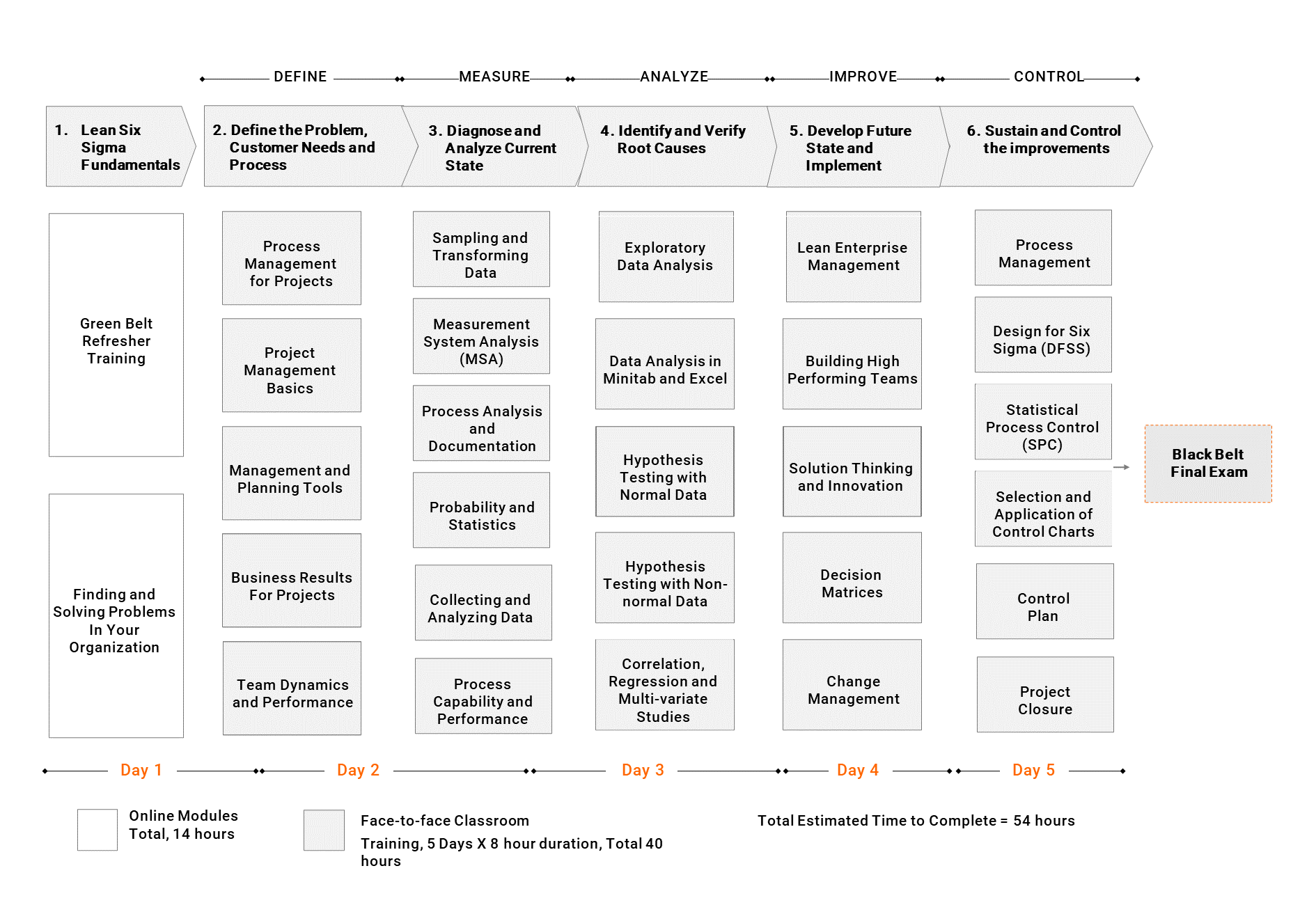
Curriculum
Modules
1.0 INTRODUCTION
Understand how lean and six sigma tools are applied to improve all types of processes in all types of enterprises: manufacturing, service, transactional, product and process design, innovation, etc.
Recognize key drivers for business (profit, market share, customer satisfaction, efficiency, product differentiation) and how key metrics and scorecards are developed and impact the entire organization.
1.1 Green Belt Refresher Training
1.2 Finding and Solving Problems in your Organisation
2.0 DEFINE
Define the scope and goals of the improvement project in terms of customer and/or business requirements, the process that delivers these requirements and stakeholder needs
2.1 Overview – Define Phase
2.2 Process Management for Projects
2.2.1 |
Process elements |
2.2.2 |
Owners and stakeholders |
2.2.3 |
Identify customers |
2.3 Translate customer requirements into performance measures
2.3.1 | Collect customer data |
2.3.2 | Analyze customer data |
2.3.3 | Translate customer requirements |
2.4 Project management basics
2.4.1 | Building a Business Case & Project Charter |
2.4.2 | Project scope |
2.4.3 | Project metrics |
2.4.4 | Project planning tools |
2.4.5 | Project documentation |
2.4.6 | Project risk analysis |
2.4.7 | Project closure |
2.5 Management and planning tools
2.6 Business results for projects
2.6.1 | Failure mode and effects analysis (FMEA) |
2.7 Team dynamics and performance
2.7.1 | Team stages and dynamics |
2.7.2 | Six sigma and other team roles and responsibilities |
2.7.3 | Team tools |
2.7.4 | Communication |
2.8 Summary – Define Phase
3.0 MEASURE
Calculate and interpret measures of dispersion and central tendency and construct and interpret frequency distributions.
Define and apply the concepts related to sampling (e.g., representative selection, homogeneity, bias, etc.) and select and use appropriate sampling methods (e.g., random sampling, stratified sampling, systematic sampling, etc.) that ensure the integrity of data. data.
Use various analytical methods (e.g., repeatability and reproducibility (R&R), correlation, bias, linearity, precision to tolerance, percent agreement, etc.) to analyze and interpret measurement system capability for variable and attribute measurement systems. Map the process and measure, understand and baseline the current process performance and capability through a set of relevant and robust measures.
Calculate process performance metrics such as defects per unit (DPU), rolled throughput yield (RTY), cost of poor quality (COPQ), defects per million opportunities (DPMO) sigma levels and process capability indices.
3.1 Overview – Measure Phase
3.2 Sampling and Transforming Data
3.2.1 | Normality (Central Limit Theorem, P-values, Transforming Data) |
3.2.2 | Sampling Methods (Random and Process Sampling, Determining Sample Sizes, Selecting Samples) |
3.2.3 | EWMA Chart |
3.3 Measurement System Analysis (MSA)
3.3.1 | Precision & Accuracy |
3.3.2 | Bias, Linearity & Stability |
3.3.3 | Gauge Repeatability & Reproducibility |
3.3.4 | Variable MSA |
3.4 Process analysis and documentation
3.4.1 | Process modeling |
3.4.2 | Process inputs and outputs |
3.5 Probability and statistics
3.5.1 | Drawing valid statistical conclusions |
3.5.2 | Central limit theorem and sampling distribution of the mean |
3.5.3 | Basic probability concepts |
3.6 Collecting and analyzing data
| 3.6.1 | Types of data and measurement scales |
| 3.6.2 | Data collection methods |
| 3.6.3 | Techniques for assuring data accuracy and integrity |
| 3.6.4 | Descriptive statistics |
| 3.6.5 | Graphical methods |
| 3.6.6 | Probability distributions |
| 3.6.7 | Measurement System Capability |
distributions
3.6.7 Measurement System Capability
3.7 Process capability and performance
3.7.1 | Process capability studies |
3.7.2 | Process performance vs. specification |
3.7.3 | Process capability indices |
3.7.4 | Process performance indices |
3.7.5 | Short-term vs. long-term capability |
3.7.6 | Process capability for attributes data |
3.8 Summary – Measure Phase
4.0 ANALYZE
Drawing valid statistical conclusions by distinguishing between descriptive and inferential studies and population and sample statistics.
Measuring and modelling relationships between variables to set-up and run hypothesis tests and correlation and regression analysis.
4.1 Overview – Analyze Phase
4.2 Exploratory data analysis
4.2.1 | Classes of Distributions |
4.2.2 | Inferential Statistics |
4.2.3 | Understanding Inference |
4.2.4 | Sampling techniques & uses |
4.2.5 | Central Limit Theorem and the principal correlations |
4.2.6 | Data Transformation, Box Cox |
4.3 How to perform data analysis in Minitab and Excel
4.4 Hypothesis testing with Normal Data
4.4.1 | General Concepts & Goals of Hypothesis Testing |
4.4.2 | Significance; Practical vs. Statistical |
4.4.3 | Risk; Alpha & Beta |
4.4.4 | Hypothesis Testing of Means, Variances and Proportions ( Z- , p- and t-tests) |
4.4.5 | 1 & 2 sample t-tests |
4.4.6 | 1 sample variance |
4.4.7 | Paired-comparison tests |
4.4.8 | Single-factor analysis of variance (ANOVA) |
4.4.9 | Tests of Equal Variances. Including Tests of Equal Variance, Normality Testing and Sample Size calculation, performing tests and interpreting results. |
4.5 Hypothesis Testing with Non-Normal Data
4.5.1 | Mann-Whitney |
4.5.2 | Kruskal-Wallis |
4.5.3 | Mood’s Median |
4.5.4 | Sample Sign |
4.5.5 | Sample Wilcoxon |
4.5.6 | One and Two Sample Proportion |
4.5.7 | Chi-Squared (Contingency Tables)a. Including Tests of Equal Variance, Normality Testing and Sample Size calculation, performing tests and interpreting results. |
4.6 Correlation, Regression and Multi-variate studies
4.6.1 | Simple linear correlation and regression |
4.7 Summary – Analyze Phase
4.6.1 | Simple linear correlation and regression |
5.0 IMPROVE
Apply divergent thinking by using creativity techniques to identify innovative solutions.
Use various tools and techniques for reducing cycle time, including continuous flow, single-minute exchange of die (SMED), etc.
How to make data driven project decisions Build High Performing Teams for project success How to Manage Resistance to Change
5.1 Overview – Improve Phase
5.2 Lean Enterprise Management
5.2.1 | Pull: Takt Time and Line Balancing, Kanban, Supermarket |
5.2.2 | Flow: Batch Reduction, Parallel Processing, Standard Work & Multi skilling, Modular Design, Layout & Cells, Quick Changeover (SMED), Level Scheduling |
5.2.3 | Steps to Perfection, Operational Equipment Effectiveness (OEE), Bottlenecks, Total Productive/Preventative Maintenance (TPM) |
5.2.4 | Assumption Busting the status quo |
5.3 Building High Performing Teams
5.4 Solution Thinking and Innovation
5.5 Decision Matrices
5.6 Change Management
5.7 Overview – Control Phase
6.0 CONTROL
Application of Six Sigma Design for Six Sigma (DFSS) Methodology to drive growth through innovation. Application of statistical process control (SPC) including control chart selection for monitoring and controlling process performance, tracking trends, runs and identifying special and common causes using rules for determining statistical control. Develop a Control Plan to emmbed Process Management principles
6.1 Overview – Control Phase
6.2 Process Management
6.3 Design for Six Sigma (DFSS) Introduction and Overview
6.4 Statistical process control (SPC)
6.4.1 | Objectives and benefits |
6.4.2 | Rational subgrouping |
6.5 Selection and application of control charts
6.5.1 | −R, |
6.5.2 | −s, individuals and moving range (ImR / XmR), median |
6.5.3 | p, np, c, and u chart |
6.5.4 | Analysis of control charts |
6.6 Selection and application of control charts
6.7 Control plan
6.8 Implement and validate solutions
6.9 Project Closure
Quizzes Segmented and embedded during and at the end of each DMAIC Phase
Final Exam Lean Six Sigma Black Belt Certification
Next Course Dates
E-Learning Modules
14 Hours
Face-to-Face Classroom Training 5 Day x 8 Hours
40 Hours
United Kingdom
Bradford
Bradford
20 -24th April 2026
Portugal
Lisbon Nov 2025 Start
Lisbon Nov 2025 Start
This blended course is run jointly with Instituto Superior Técnico and Erising.
Session 1
(2 Day Face-to-Face or Remote) – 17th and 18th Nov 2025
Daily Timing: 09:00 – 17:00
Venue: Instituto Superior TécnicoSession 2 (Remote) – Thu 27th Nov 2025
Session 3 (Remote) – Thu 4th Dec 2025
Session 4 (Remote) – Thu 11th Dec 2025
All remote sessions timing 08:30 – 14:30 Hrs. (6 hrs per session)
Classroom training sessions take place in-person between 09:00 to 17:00 BST / 08.00 to 16:00 UTC
Estimated time to complete
54 Hours
Course Duration
5 Days
Course Fee (excluding VAT)
£ 2,695
What's Included
- Five days of intensive, face-to-face classroom training delivered by a Master Black Belt
- Immersive classroom learning with experienced practitioners from diverse industries
- 12 months access to the Black Belt Bootcamp platform, including advanced tools, case studies and resources
- Green Belt refresher modules included to ensure a consistent starting point
- Black Belt final exam and electronic certificate
- Ongoing tutor support and peer discussion
- Access to a global Lean Six Sigma learning community
Program Features
The quickest, easiest and most engaging way for individuals and companies to get on track with Lean Six Sigma concepts and tools.
In-person and virtual workshops
Ready-to-use job aids, tools and templates
Peer-to-peer learning forums
Distinctive digital learning content
Expert coaching support
Nudges, reminders and micro learning
Excellent for remote teams
Auto-translate curriculum and instruction
Multi-channel; eLearning, virtual, face-to-face or in-house
Make progress in less time and deliver results quickly
Tailored learning solutions for companies
Mobile friendly
Highly practical
Join our Lean Six Sigma community
Practice exams
World Class Lean Six Sigma Certification
Complete your Black Belt through immersive classroom learning